
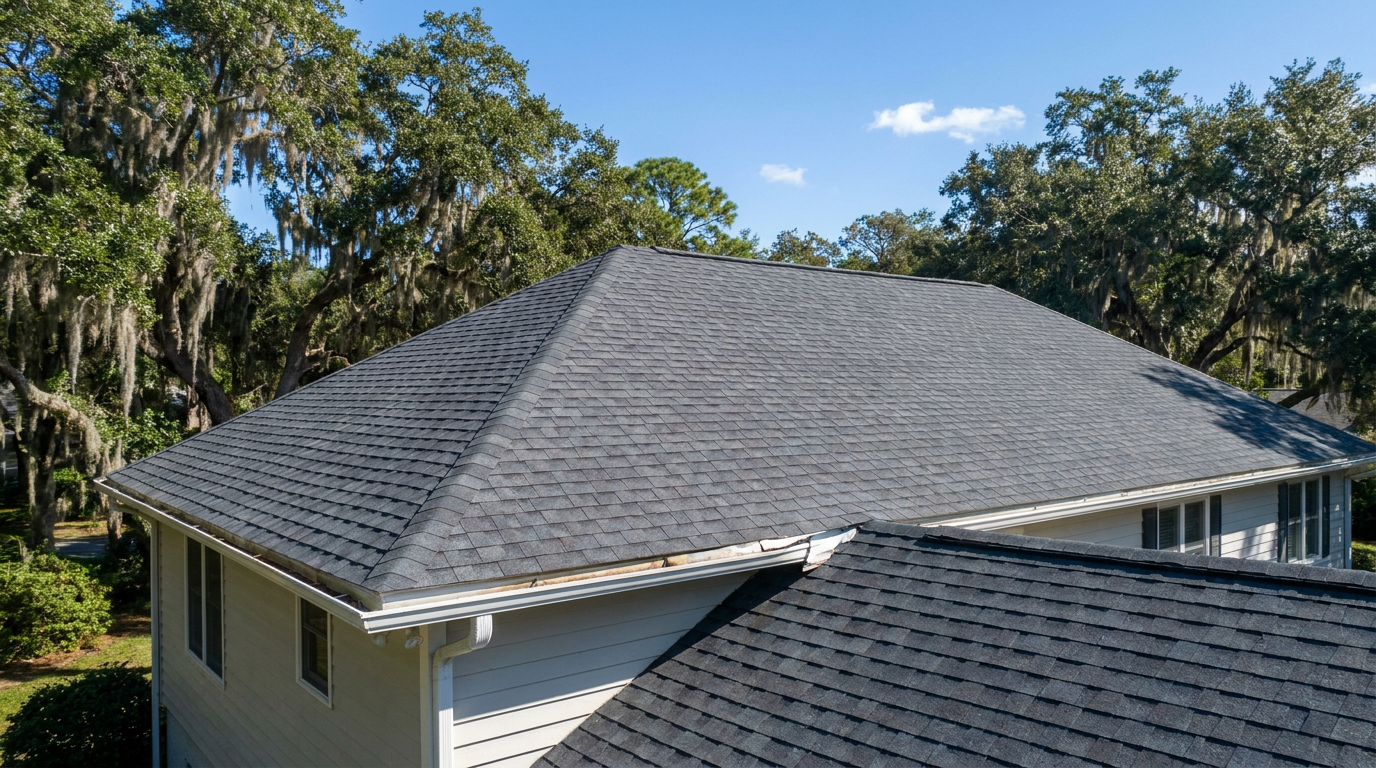
Living on St. Simons Island offers unparalleled coastal beauty, but it also places your home on the front lines of some of the most intense weather in the Southeast. After a heavy Georgia rainstorm, most homeowners look up at their shingles to check for missing tabs. However, the most critical damage often occurs where you least expect it: at the roof’s edge. Your gutters and fascia boards are your home’s first line of defense against water intrusion, and when they fail, the structural integrity of your entire roofing system is at risk.
The Role of Gutters and Fascia in Coastal Georgia
In the humid, high-precipitation environment of the Georgia coast, gutters and fascia work as a unified system. The gutters collect the deluge of rainwater, while the fascia—the long, horizontal board that runs along the edge of your roof—acts as the support structure for those gutters and a barrier for your rafters.
When a coastal storm hits, the volume of water can be staggering. Without a functional gutter system, that water flows directly off the roof and pools at your foundation or, worse, wicks backward into the wooden components of your roof deck. In St. Simons Island, where humidity levels rarely drop, once moisture enters the wood, it stays there, inviting rot and mold long after the clouds have cleared.
Common Signs of Gutter Failure After Heavy Rain
Heavy rainfall acts as a stress test for your drainage system. If you notice any of the following after a storm, your gutters may be compromised:
Sagging or Pulling Away
Standard gutters are held to the fascia with spikes or brackets. Heavy rain adds immense weight, especially if the gutters are partially clogged with pine needles or debris. If the hardware loosens, the gutters will sag, creating a gap where water can pour directly onto the fascia board.
Overflowing and "Tiger Striping"
If water spills over the front of the gutter despite them being clear of debris, the pitch may be incorrect, or the system may be undersized for Georgia’s tropical downpours. Those dark vertical streaks on the outside of your gutters, known as "tiger striping," are a sign that water is consistently overflowing and carrying pollutants over the edge.
Foundation Erosion
If you see trenches forming in your landscaping or mulch being washed away directly under the roofline, your gutters are not successfully diverting water to the downspouts. This can lead to basement leaks or foundation settling over time.
Identifying Fascia Damage and Wood Rot
Fascia damage is often more sinister than gutter damage because it is frequently hidden behind the gutter itself. In the Southeast, the combination of heat and moisture creates a "greenhouse effect" that accelerates wood decay.
Soft Spots and Crumbling Paint
Take a walk around your home's perimeter. If you see paint peeling or bubbling on the fascia boards, moisture is likely trapped behind the surface. If the wood appears soft or shows signs of "alligatoring" (cracking that looks like reptile skin), the structural integrity of the board is likely gone.
Mold and Algae Growth
St. Simons Island homeowners are no strangers to gloeocapsa magma (the black algae often seen on roofs). However, if you see green moss or fuzzy mold growing on your fascia, it indicates a chronic moisture problem. These organisms feed on the organic matter in the wood, weakening it until it can no longer support the weight of your gutter system.
Pest Infestations
Damp wood is a magnet for pests common in Georgia, such as termites, carpenter ants, and even rodents. A compromised fascia board provides an easy entry point for these pests to enter your attic space, leading to much more expensive repairs inside the home.
The Impact of the Georgia Climate on Roof Edges
Our local climate presents unique challenges that inland contractors might overlook. The salt air of the Golden Isles can accelerate the corrosion of metal fasteners, while the intense UV rays break down the protective sealants used in gutter installations.
Furthermore, during hurricane season, the high winds can catch the lip of a gutter that has been weakened by previous rains. If the fascia is rotted, the wind can literally rip the entire gutter system off the house, taking a portion of the roof deck with it. This is why regular inspections following heavy rain events are not just a recommendation—they are a necessity for coastal property maintenance.
Preventing Long-Term Structural Issues
Preventing gutter and fascia damage starts with ensuring your roof's "drip edge" is installed correctly. A drip edge is a metal flashing that guides water into the gutter and prevents it from running behind the gutter and onto the fascia.
If your home was built or reroofed without a proper drip edge, or if it was damaged during a storm, your fascia boards are essentially being soaked every time it rains. Upgrading to seamless gutters and ensuring your fascia is capped with aluminum or vinyl can provide a much higher level of protection against the humid Georgia elements.
Schedule a Professional Inspection in St. Simons Island
Roofing issues rarely get cheaper the longer you wait. What starts as a small leak behind a gutter can quickly evolve into a full-scale roof replacement if the rafters begin to rot. Because much of this damage occurs high above the ground and behind metal components, it is difficult for the average homeowner to assess the full extent of the risk safely.
Diamond Roof Restorations specializes in the unique needs of Georgia, Florida, and South Carolina homeowners. Our team understands how to spot the early warning signs of water intrusion and provide solutions that stand up to the humidity and storms of the Southeast.
Protect your home from the next big storm. Contact Diamond Roof Restorations today at (912) 207-6273 to schedule your free, no-obligation inspection. Let us ensure your gutters and fascia are ready to handle whatever the Georgia sky throws your way.