
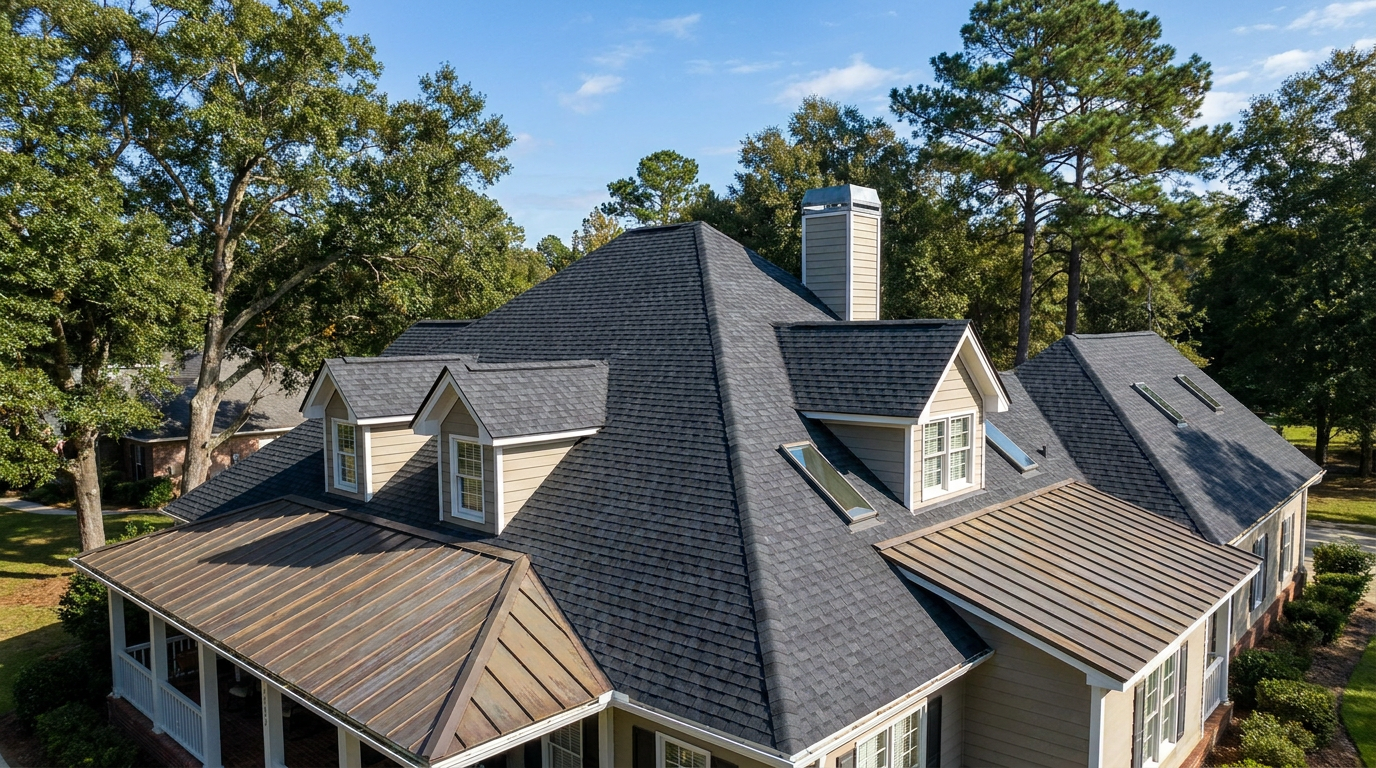
For homeowners in Baxley, Georgia, a roof leak is rarely as obvious as a steady drip from the ceiling during a thunderstorm. More often, water intrusion is a silent, creeping issue that hides behind drywall, inside insulation, and within the structural skeleton of your home. By the time you see a yellow stain on your ceiling, the damage may have been progressing for months.
In the humid, high-moisture environment of the Southeast, even a minor breach can lead to rapid rot and mold growth. At Diamond Roof Restorations, we frequently see three primary culprits when it comes to "hidden" leaks: skylights, roof valleys, and metal flashing. Understanding how these components fail is the first step in protecting your investment.
The Vulnerability of Roof Valleys
A roof valley is the V-shaped angle where two sloping roof planes meet. Because these areas act as a natural gutter for your roof, they handle a higher volume of water than any other part of the system. In Baxley, where seasonal downpours can dump inches of rain in a single afternoon, valleys are under immense pressure.
Debris Accumulation and Damming
One of the most common causes of valley leaks in Georgia is the accumulation of pine needles, leaves, and twigs. When debris builds up in the valley, it creates a dam. Rainwater, instead of flowing freely into the gutters, backs up under the shingles. Over time, this standing water degrades the underlayment and seeps into the decking.
Improper Installation and Wear
Valleys are typically finished in one of two ways: "closed" (where shingles are woven or overlapped) or "open" (where a metal U-channel is installed). If the shingles in a closed valley are not cut correctly, or if the metal lining in an open valley has rusted or shifted, water will find its way in. Because the leak occurs at the junction of two roof planes, the water often travels down the rafters, dripping far from the actual entry point, making it difficult for a homeowner to locate.
Skylights: The Beautiful Liability
Skylights are fantastic for bringing natural light into Georgia homes, but they are essentially a large hole cut into your roof. Even the highest-quality skylight is only as good as the seal surrounding it. In the Southeast, our extreme temperature fluctuations—from blistering 90-degree summer days to freezing winter nights—cause materials to expand and contract constantly.
Sealant Failure and Condensation
Many homeowners mistake condensation for a leak, but in many cases, it is both. If the weatherstripping around the glass fails, humid Georgia air enters the gap, condenses, and drips. More seriously, the rubber gaskets used in skylight construction can dry out and crack due to intense UV exposure. Once the seal is compromised, water can bypass the frame and enter the attic space unnoticed.
The Importance of Flashing Kits
Most skylight leaks don't actually come from the glass; they come from the flashing—the metal curbing that directs water around the unit. If this flashing was improperly integrated with the shingles, or if the caulking has pulled away, water will seep behind the frame. Because skylights are often located above finished living areas, these leaks can cause significant damage to interior drywall before they are detected.
Flashing: Your Roof's Most Critical Defense
Flashing is the thin material—usually galvanized steel, aluminum, or copper—installed to direct water away from critical areas such as chimneys, vent pipes, and where the roof meets a vertical wall. It is the most common point of failure on any roof in South Carolina or Florida.
Chimney and Step Flashing
Chimneys are notorious for hidden leaks. They require "step flashing" (individual L-shaped pieces woven between shingles) and "counter-flashing" (embedded into the brick mortar). Over time, the mortar can crumble, or the metal can pull away from the brick. Water then runs down the side of the chimney behind the siding, where it can rot the framing without ever showing a spot on the ceiling.
The Impact of Southeast Weather on Metal
In coastal-adjacent areas like Baxley, the air carries moisture that can accelerate the corrosion of inferior metal flashing. Additionally, the high winds from tropical storms and hurricanes can lift the edges of flashing just enough to allow wind-driven rain to blow underneath. Once the integrity of the flashing is compromised, the wood underneath stays damp, creating a breeding ground for Gloeocapsa Magma (the black algae common in the South) and wood-destroying fungi.
Why Professional Detection Matters
Finding a hidden leak requires more than just a ladder and a flashlight. It requires an understanding of how water travels. Because water follows the path of least resistance, the entry point on the outside of the roof is rarely directly above the spot where the water finally appears inside.
At Diamond Roof Restorations, we use a systematic approach to identify these vulnerabilities. We check for:
- Soft Spots: Areas of the decking that feel spongy, indicating long-term moisture.
- Granule Loss: Heavy accumulation in valleys that suggests accelerated wear.
- Rusted Fasteners: Evidence that moisture is consistently getting under the shingle layer.
- Discolored Insulation: A tell-tale sign that a slow leak is evaporating before it hits your ceiling.
Protect Your Home with Diamond Roof Restorations
Your roof is a complex system, and the "invisible" components like valleys and flashing are what keep your home dry. In Baxley, GA, and throughout the Southeast, the elements are constantly working against your roof's integrity. Don't wait for a major storm to reveal a hidden problem.
If you suspect your roof is aging or you’ve noticed subtle signs of moisture, it’s time for a professional evaluation. Diamond Roof Restorations specializes in identifying and repairing these hidden threats before they become costly replacements.
Secure your home’s future today. Contact Diamond Roof Restorations at (912) 207-6273 to schedule your comprehensive free inspection. We proudly serve homeowners across Georgia, Florida, and South Carolina with expert craftsmanship and local reliability.