
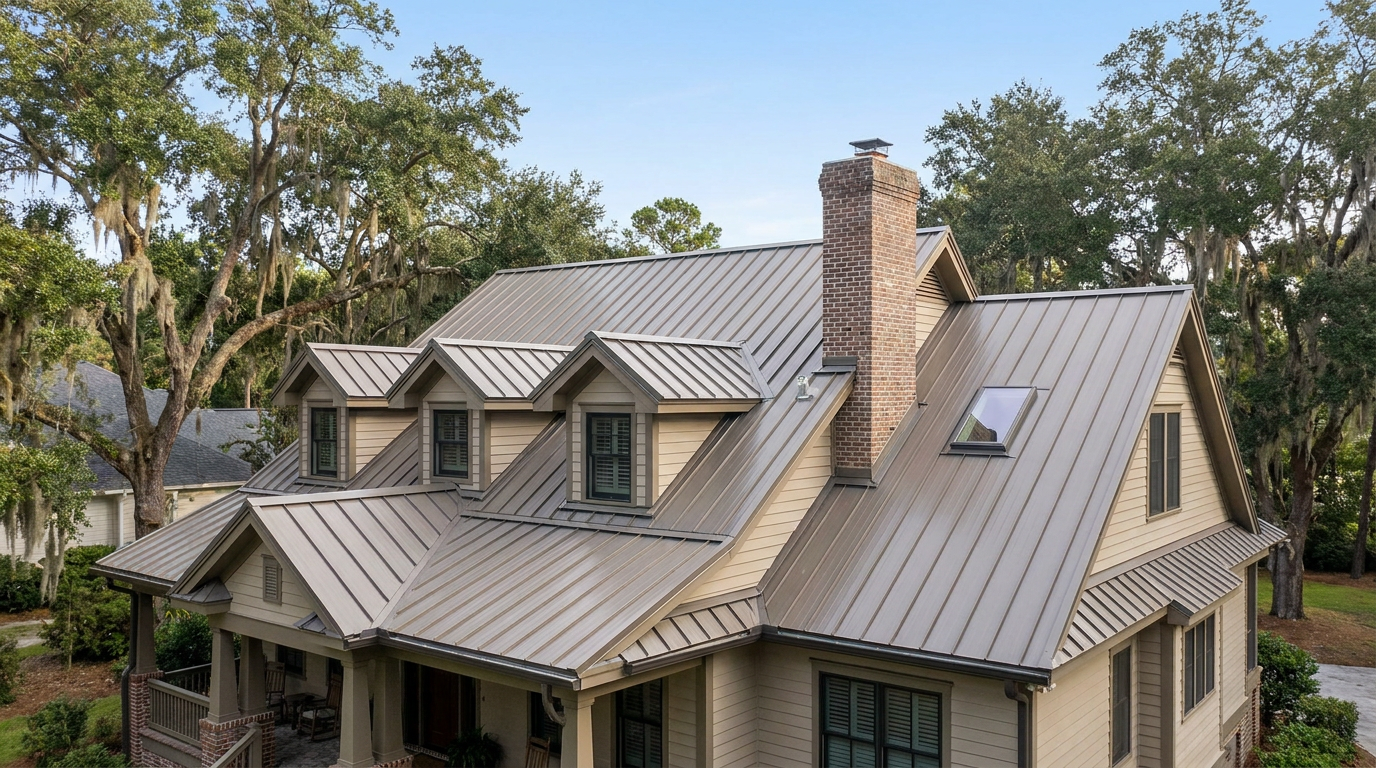
Living in Richmond Hill means enjoying the coastal beauty of the Ogeechee River and the lush landscapes of South Georgia. However, it also means subjecting your home to some of the most punishing roofing conditions in the country. Between the stifling humidity that encourages organic growth and the sudden, torrential downpours of hurricane season, your roof is your first line of defense.
Often, the most dangerous roof leaks aren't the ones that leave a puddle in the middle of your living room floor. The most destructive leaks are the silent ones—moisture that creeps into your attic, rots your decking, and breeds mold long before you see a stain on your ceiling. These "hidden" leaks almost always originate in three specific high-risk areas: skylights, roof valleys, and flashing.
The Vulnerability of Skylights in the Southeast
Skylights are a beautiful addition to any Georgia home, bringing in natural light and making spaces feel larger. However, in the roofing industry, we often say there are two types of skylights: those that leak and those that haven't started leaking yet.
Why Skylights Fail
In our region, the intense UV radiation from the sun can degrade the rubber gaskets and seals around a skylight faster than in cooler climates. As these seals dry out and crack, they create tiny pathways for water. Furthermore, the high humidity in Richmond Hill can lead to condensation issues that homeowners often mistake for a leak, though both require professional attention to prevent wood rot.
Improper Flashing Around Glass
Most skylight leaks aren't actually the glass itself; it is the flashing kit surrounding the frame. If the flashing wasn't integrated correctly with the shingles, or if debris like pine needles and oak leaves build up behind the top saddle, water backs up under the shingles. During a heavy Georgia thunderstorm, this standing water will eventually find its way into your home.
Roof Valleys: The High-Traffic Waterways
Your roof valleys are the internal angles formed where two roof slopes meet. Think of them as the gutters of your roof surface. During a heavy downpour, an immense volume of water is channeled through these valleys at high velocity.
Debris Accumulation and Damming
In wooded areas of Richmond Hill, valleys are magnets for falling debris. When leaves, twigs, and Spanish moss collect in a valley, they create a "dam." This forces water to move sideways, often pushing it underneath the shingles where it can reach the underlayment. If your underlayment is aged or was poorly installed, that water will penetrate the decking.
Material Fatigue
Because valleys handle more water than any other part of the roof, they wear out faster. Whether you have a "closed" valley (where shingles overlap) or an "open" valley (often lined with metal), the constant friction of rushing water and the expansion/contraction caused by Georgia’s temperature swings can cause the materials to crack or lift.
The Role of Flashing: Your Roof’s Weakest Links
Flashing is the thin material—usually galvanized steel or aluminum—installed to direct water away from critical areas where the roof plane meets a vertical surface, such as a chimney, a dormer, or a wall.
Chimney Flashing Failures
Chimneys are notorious for hidden leaks. Because they are often built from brick or stone, they are porous. If the counter-flashing (the metal embedded into the mortar) becomes loose, water will run down the side of the chimney and straight into your attic. In the Southeast, the frequent freeze-thaw cycles (though rare, they do happen) can cause mortar to crack, further compromising the flashing's integrity.
Step Flashing and Wall Intersections
Step flashing consists of individual L-shaped pieces of metal tucked under each shingle along a wall. If a single piece is missing, rusted, or improperly nailed, it creates a gap. Because these gaps are usually hidden behind siding or shingles, you won't know there is a problem until the interior drywall begins to soft-rot or show signs of mildew.
The Silent Threat: Humidity and Mold
In Richmond Hill, a small leak isn't just a structural issue—it's a health concern. Our high relative humidity means that once water enters a dark, warm attic space, mold can begin to grow within 24 to 48 hours. A hidden leak in a valley or around a skylight can saturate your insulation, rendering it useless and driving up your cooling costs during the scorching Georgia summer.
Furthermore, the Southeast is prone to Gloeocapsa Magma—the black streaks you see on roofs. While this algae primarily feeds on the limestone in shingles, it also retains moisture. If this algae grows around your flashing or in your valleys, it keeps those areas damp for longer periods, accelerating the corrosion of metal components and the rot of organic shingle bases.
How to Spot a Hidden Leak Before It’s Too Late
While we always recommend a professional inspection, homeowners can look for these red flags:
- Dark Streaks on Siding: This often indicates that flashing above the wall has failed.
- Granule Loss in Valleys: If you see piles of shingle granules at the base of your downspouts, your valleys may be thinning out.
- Musty Odors: A persistent musty smell in the attic or a specific room usually points to a slow, hidden moisture intrusion.
- Discolored Skylight Frames: If the wood or drywall immediately surrounding your skylight looks darker than the rest, moisture is getting in.
Protect Your Home with Diamond Roof Restorations
Your roof is a complex system, and the transitions—the skylights, valleys, and flashing—are the most likely points of failure. Don't wait for a major storm to reveal a problem that has been brewing for months.
Diamond Roof Restorations serves homeowners throughout Richmond Hill, GA, and across Georgia, South Carolina, and Florida. We understand the specific challenges posed by coastal weather and Southeast humidity. Our team specializes in identifying these hidden vulnerabilities and providing long-term solutions that protect your investment.
Is your roof ready for the next season of Georgia weather? Contact Diamond Roof Restorations today at (912) 207-6273 to schedule your comprehensive free inspection. Let us give you the peace of mind that comes with a truly watertight home.