
How much cooling energy can a commercial roof coating save?
See what researchers measured after coating a Florida shopping plaza and a school, and how to compare cooling electricity and peak demand at your building.
Seven shops shared a roof. Their cooling savings varied.
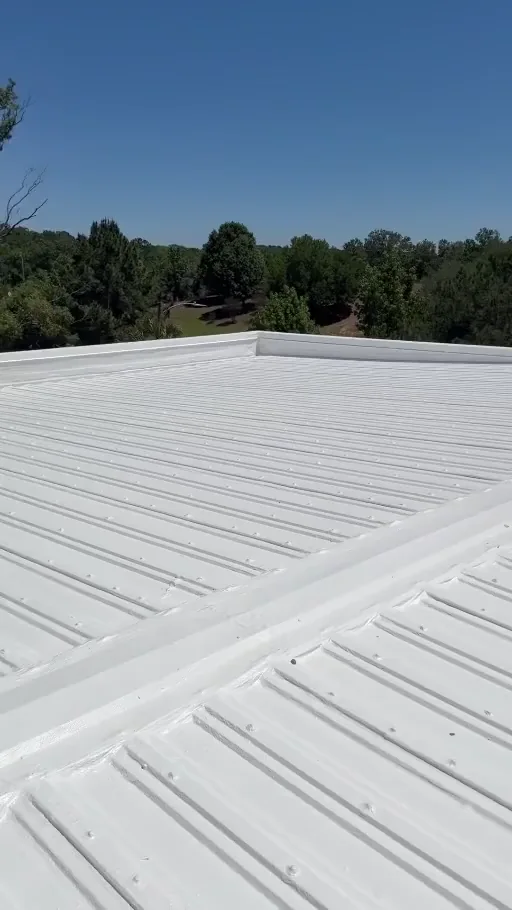
At a shopping plaza in Cocoa, Florida, each tenant had its own air conditioner. Researchers metered seven of those systems as a white acrylic coating went onto the galvanized metal roof in stages during the summers of 1996 and 1997. The roof had R-11 insulation, and both the ducts and air handlers sat in the space beneath it.
Across the seven shops, average summer cooling electricity dropped from 34.1 to 25.5 kilowatt-hours per shop per day. That was a 25.3% reduction. The bagel shop used about 13% less cooling electricity, while the bookstore used about 48% less. The meters covered air conditioning. Refrigerators, lights and other loads still had their own energy costs. Read the Florida Solar Energy Center’s October 1997 retail study.
-
Seven-shop average25.3%
-
Bagel shopAbout 13%
-
BookstoreAbout 48%
The average summarizes seven metered air conditioners; the two individual shops illustrate the variation. Each result uses its own baseline. Other building electricity use is outside these measurements.
At a Florida school, the biggest change came in the afternoon
Researchers monitored a 10,000-square-foot elementary school in Cocoa Beach for a year before and a year after a white acrylic coating went onto its gray modified-bitumen roof in May 1995. The chiller used about 13,000 fewer kilowatt-hours over the following year, a decline of roughly 10%.
The study also looked at how much power the cooling system drew during the utility’s summer weekday peak hour. Average demand in that hour fell by 5.6 kilowatts, or 35%. Kilowatts measure the rate of electricity use. Kilowatt-hours measure how much energy equipment uses over time. A building’s demand charge depends on its rate plan and when its whole-building meter records a peak. Read the June 1996 school study.
-
Cocoa Beach schoolAbout 10%
The monitored chiller used about 13,000 fewer kWh. This is a result from the study building, not a savings forecast for your property.
-
Cocoa Beach school35%
The reported drop was 5.6 kW during the studied peak hour. This measures power at that time; annual electricity use is shown separately.
How to check the benefit at your building
Before the work, establish a baseline. Save a year of bills if available. Ask your utility for interval data and your facilities team for cooling-system meter readings. Document which spaces are cooled, operating hours, thermostat schedules, roof insulation and where ducts run.
Compare similar days. Record the coating date. Compare pre- and post-coating days with similar weather, opening hours and occupancy. Flag HVAC replacements or schedule changes. A hotter July, a new tenant or a longer shift can change the meter reading on its own.
Report what the meter covers. For a dedicated cooling meter, compare kWh per operating day. For a whole-building meter, describe the result as a change in total electricity use. If the account has a demand charge, compare billed peak kW separately. These records give a property manager a defensible way to discuss any savings alongside the condition and repair needs of the roof.
For a Georgia example of the roof work itself, see the metal restoration scope at TideWater Trailer Supply in Savannah. Diamond sealed the panel seams and fasteners before applying acrylic. The project record documents those repairs. The energy measurements above come from the Florida research sites.