
Restore or replace a leaking commercial roof?
Ask the roofer to mark which sections can stay, which need to come out and why. Here’s how to use that roof plan to compare two proposals.
Evidence guide · government and peer-reviewed sources
A reflective coating can keep a sunlit roof cooler. How much cooling electricity that saves depends on the building. Here’s what researchers measured and what Diamond checks before recommending a coating.
Ask the roofer to mark which sections can stay, which need to come out and why. Here’s how to use that roof plan to compare two proposals.
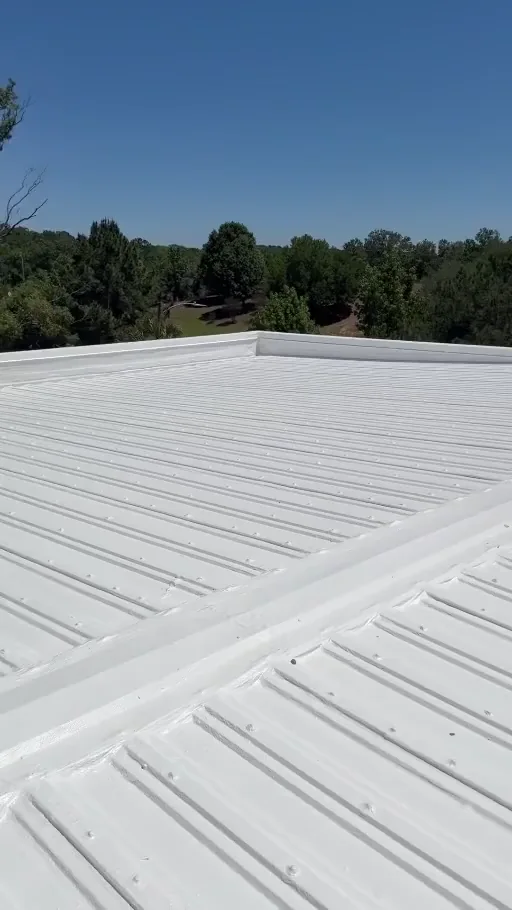
Seven Florida shops shared one metal roof. After a white coating went on, their air conditioners used an average of 8.6 fewer kilowatt-hours per shop per summer day. What would you need to measure to find out whether your own building benefits?
Two bids can both say “white silicone” and still describe different systems. Look up the exact product, compare how much sunlight it reflects after weathering, and use our two-bid worksheet to put repairs and warranty terms side by side.
The short answer
By reflecting more sunlight, a cool roof absorbs less heat. In monitored California buildings, applying a white reflective coating lowered peak roof-surface temperature substantially.
Field measurements and simulations show cooling-energy savings in many warm-climate commercial buildings. Savings are not guaranteed and can be small in some buildings.
EPA identifies cool roofs as one strategy that can reduce building heat gain and urban heat. The benefit is greatest when many suitable roofs use reflective surfaces.
On an eligible roof, a fluid-applied system may restore the surface after repairs. This is a project decision—not a scientific promise—and wet or deteriorated sections may still need removal.
Read the results visually
The charts use the reported percentages on a full 0–100 scale. The first two summarize monitored buildings; the third shows the surface assumptions used in a computer model.
Measured surface reflectance for the study conditions. These values do not describe a specific Diamond coating product.
Source: LBNL field demonstration
Each bar compares a building with its own baseline. Results cover cooling equipment only and vary by building.
Source: LBNL field demonstration
The model assigned these surface properties to prototype buildings. They are not product test results or predicted energy savings.
Source: LBNL national simulation
What the published evidence says
Numbers are useful only when the study design travels with them. The table separates monitored buildings from computer simulations and keeps each result in its original context.
| Primary source | Study design | Reported result | Important limitation |
|---|---|---|---|
| Lawrence Berkeley National Laboratory field demonstration (1998) | In the California summer, researchers monitored white elastomeric coatings over granular asphalt cap sheets. The Davis and Gilroy medical offices had gray cap sheets over built-up roofing. The San Jose retail site had a tan cap sheet. | The share of sunlight reflected rose from about 20% to 60%. On hot, sunny summer afternoons the roof surface fell from about 175°F to 120°F. Average daily summer air-conditioning electricity fell 18% at the Davis office, 13% at the Gilroy office and 2% at the San Jose store. | These readings cover three California buildings. The energy meters measured air conditioning only. |
| LBNL / Energy and Buildings monitoring study (2005) | Six California buildings in three locations were monitored. The Sacramento store’s mineral cap sheet received an elastomeric coating. The San Marcos school received a white PVC membrane over gray cap sheet. At the Reedley cold-storage site, crews coated existing black EPDM and standing-seam metal. The July 2004 field report describes these roofs and California climate zones 12, 10 and 13, respectively. | Daily peak roof-surface temperatures fell by about 59–76°F (33–42°C). For similar schools in California climate zones 2–16, the researchers estimated annual cooling savings of 3–6 kWh per square meter of conditioned roof area. | The temperature range includes several roof systems. The school energy figures come from simulations based on the PVC-roof school and apply to the modeled California climates. |
| LBNL national commercial-building simulation (2010) | Researchers modeled older and newer office and retail buildings in 236 U.S. city climates. Their roof inputs represent surfaces reflecting 55% of sunlight when weathered white and 20% when gray. The model assigns these surface properties without specifying a single coating product. | Per square meter of conditioned roof area, the national model estimated annual cooling savings of 5.02 kWh, extra heating use of 0.065 therm and a CO₂ reduction of 3.02 kg. | The estimates use prototype buildings and historical energy data. A particular building’s operation and utility rates can change the result. |
| U.S. EPA cool-roof guidance | Government synthesis of cool-roof performance and heat-island research. | EPA explains that high solar reflectance and thermal emittance can reduce roof and indoor temperatures, cooling demand and peak electricity demand. | EPA also notes a possible winter heating penalty in colder climates. It does not guarantee savings for a particular building. |
Albedo is the fraction of incoming sunlight reflected by a surface. The field study uses the term; EPA commonly uses “solar reflectance.” Temperature reductions and energy savings are different measurements and should not be combined into one claim.
Why results vary
A bright coating can reflect sunlight, but the building beneath it determines how much that matters to the utility bill.
Climate and seasonHot, sunny locations generally have more cooling opportunity; cold climates can have a winter heating tradeoff.
Existing insulationA well-insulated roof may transfer less heat already, reducing the incremental energy effect.
Building use and HVACHours, thermostat settings, equipment efficiency, internal loads and conditioned area all change the result.
Weathered reflectancePerformance after dirt and aging matters more than a new product sample. DOE research specifically addresses long-term cleanliness and durability.
Roof conditionReflectivity does not repair wet insulation, failed seams, deteriorated decking or poor drainage.
The U.S. Department of Energy’s 2014 research summary describes targets for retaining reflectance as a coating ages. Ask for the selected product’s aged reflectance rating and written warranty.
What an assessment should answer
Diamond reviews the existing assembly, leak history, drainage, attachment, corrosion and visible damage. Moisture testing or selective investigation may be needed before a restoration decision.
The proposed primer and coating must be compatible with the actual roof. Preparation and an adhesion test should follow the selected manufacturer’s written requirements.
Fasteners, seams, penetrations, curbs, flashings and wet sections belong in the scope. A coating is the finished system, not a substitute for repairing failed details.
Keep the scope, product data, application records, inspection photos and issued warranty. Energy performance should be discussed as a building-specific estimate, not a guaranteed percentage.